What to Review When Sales Says a Lead Was Not Ready
When sales pushes back that an inbound lead was not ready, don't guess whether the intake failed or the prospect evolved—audit the agreed qualification questions and establish clear change governance.
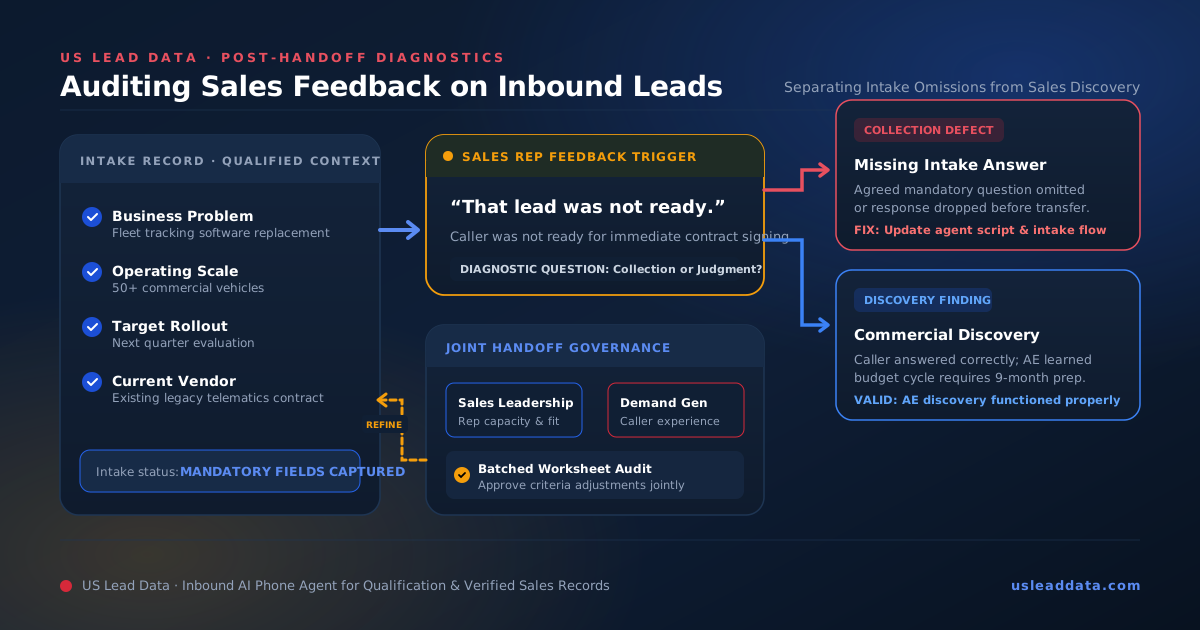
When an inbound sales representative finishes a call and reports, "That lead wasn't ready," it is easy for demand-generation and sales teams to slip into familiar friction. Marketing points to the intake record showing that the caller answered every agreed question. Sales counters that the prospect lacked immediate authority, had an uncommitted budget, or was merely conducting exploratory research.
Without a structured review process, this disagreement usually leads to one of two unhelpful reactions: either marketing dismisses the rep's feedback as anecdotal resistance, or the team impulsively piles five additional disqualifying questions onto the phone intake, causing high-intent callers to drop off.
Neither reaction solves the underlying problem. A disciplined B2B revenue team does not treat sales feedback as a binary debate over lead quality. Instead, they treat it as an operational audit of their qualification criteria and handoff thresholds.
When sales says a lead was not ready, reviewing that feedback constructively requires three explicit decisions:
- Separating a missing intake answer from commercial sales judgment;
- Identifying which agreed qualification question should be revisited; and
- Deciding who has the authority to approve a change to the handoff rule.
Here is how B2B sales and demand-generation leaders can audit sales feedback, preserve caller experience, and keep handoff definitions aligned.
1. Separate a missing intake answer from sales judgment
The first step in evaluating sales feedback is categorizing the nature of the rep's objection. Inbound handoffs involve two fundamentally different kinds of information: objective intake context gathered during the initial call, and subjective commercial judgment developed during downstream discovery.
Conflating these two creates confusion across the revenue team.
+---------------------------------------------------------------------------------+
|                       EVALUATING INBOUND SALES FEEDBACK                         |
+---------------------------------------------------------------------------------+
|  OBJECTIVE INTAKE DATA                          SUBJECTIVE SALES JUDGMENT       |
|  - Stated business problem                      - Buying committee consensus    |
|  - Operating scale / locations                  - Budget allocation reality     |
|  - Current software / vendor                    - Solution architecture fit     |
|  - Desired rollout timeline                     - Commercial viability & urgency|
|                                                                                 |
|  [Intake Agent Job: Context Gathering]         [Sales Rep Job: Opportunity Fit] |
+---------------------------------------------------------------------------------+
What is a missing intake answer?
A missing intake answer occurs when the inbound phone agent failed to gather an explicit fact that was already defined as mandatory in the agreed handoff rule.
- Example: The handoff rule specifies that reps require the caller's current software provider and number of licensed seats before a transfer. If the lead record arrives with those fields blank or vague, that is a collection failure.
- Operational diagnosis: The intake agent flow or script omitted an agreed question, or the caller's answer was not parsed into the handoff record. This is an intake execution problem that can be corrected directly in the intake flow.
What is sales judgment?
Sales judgment occurs when the caller accurately provided all required intake information, but the sales representative evaluated the commercial opportunity as weak or premature after deeper discovery.
- Example: The caller stated during intake that they plan to evaluate solutions this quarter (passing the timeline threshold). During the subsequent discovery call, the account executive learned that the caller's department head has not yet approved capital expenditure for the initiative.
- Operational diagnosis: The intake agent successfully captured the prospect's stated timeline. The discovery that capital expenditure remains unallocated is the direct result of professional sales qualification, not a defect in the intake agent.
When a team conflates sales judgment with intake failure, they often attempt to force the phone intake to do the account executive's job. Inbound phone qualification is designed to establish basic fit, gather stated intent, and ensure the caller is worth a live conversation. It is not designed to replace comprehensive commercial discovery.
2. Identify which agreed qualification question should be revisited
Once you verify that an intake answer was indeed captured, the next step is determining whether the underlying criteria or question wording itself needs refinement.
When sales consistently reports that callers meeting a specific criterion are unprepared for a sales conversation, the team must audit the specific question in the qualification rubric:
Intent questions: Why did the caller reach out?
- Common sales pushback: "The caller just wanted a generic price list or a quick technical spec; they didn't have an active project."
- Question review: How did the intake agent phrase the inquiry question? Did it merely ask, "How can we help you?" (which invites casual browsing), or did it ask, "What specific operational challenge are you looking to solve?"
- Adjustment consideration: Tightening the intent question helps distinguish active evaluation from passive information gathering without turning the call into an interrogation.
Fit questions: Does the organization match your operating model?
- Common sales pushback: "The company is far below our minimum seat threshold or outside our serviced geographic region."
- Question review: Did the handoff rule include an explicit threshold question for company size, fleet count, or geographic footprint?
- Adjustment consideration: If sales is spending time on organizations that cannot use the product, an explicit filter question should be confirmed during initial intake before routing the lead to a senior representative.
Authority and role questions: Who is evaluating the solution?
- Common sales pushback: "The caller is an individual contributor doing independent research who cannot schedule a team evaluation."
- Question review: Did the intake ask the caller's role and whether other stakeholders are involved in the initiative?
- Adjustment consideration: Rather than rejecting non-decision-makers outright, the handoff rule can specify that individual researchers receive informational resources or an email follow-up, reserving direct rep routing for evaluators with buying influence.
Timeline and urgency questions: When do they need a solution?
- Common sales pushback: "They are planning for twelve to eighteen months from now."
- Question review: What timeline window was originally agreed upon in the handoff rule? If the rule accepted any stated timeline within twelve months, the intake agent performed as configured.
- Adjustment consideration: If sales pipeline capacity requires narrowing the window to 90 or 180 days, the handoff threshold should be adjusted—not because the intake erred, but because business parameters changed.
3. A blank sales feedback worksheet for post-handoff reviews
To prevent subjective arguments and keep feedback focused on operational facts, revenue teams should review contested leads using a standardized worksheet.
The following blank worksheet provides a disciplined structure for joint sales and demand-generation reviews:
Inbound lead handoff feedback worksheet
| Field | Review Details |
|---|---|
| Lead Record ID & Date | [Record identifier, call timestamp, assigned representative] |
| Agreed Handoff Rule Applied | [Specific rule version or handoff criteria active at time of call] |
| Caller Stated Context | [Summary of caller stated intent, fit details, and timeline captured] |
| Sales Rep Feedback | [Exact reason sales flagged the lead as "not ready"] |
| Feedback Classification | [ ] Missing Intake Answer (collection failure) [ ] Sales Discovery Judgment (commercial fit finding) [ ] Handoff Rule Misalignment (criteria threshold mismatch) |
| Qualification Question Under Review | [Specific question: Intent / Organization Fit / Role / Timeline] |
| Root Cause Finding | [Explanation: Question omitted / Ambiguous answer / Threshold too wide / Discovery nuance] |
| Recommended Action | [ ] No change to intake (discovery did its job) [ ] Clarify question wording in intake flow [ ] Adjust qualification threshold in handoff rule [ ] Route to alternative follow-up path (nurture / email) |
| Change Approval Required? | [ ] Yes (escalate to joint governance) [ ] No (intake execution correction) |
Note: This blank worksheet is an illustrative operational planning tool for internal team alignment; it does not claim automated lead scoring, CRM integration, verified lead outcomes, or guaranteed conversion rates.
By documenting feedback in this format across a sample of calls (for instance, five to ten contested handoffs), leaders can spot systemic patterns rather than reacting to isolated rep frustrations.
4. Decide who approves a change to the handoff rule
A common operational failure in inbound lead management is ambiguous change authority. When reps are unhappy with call readiness, individual sales managers often try to rewrite intake requirements ad hoc, while marketing managers resist changes that might reduce inbound volume.
To maintain alignment, the revenue team must establish clear governance over handoff rule modifications.
+---------------------------------------------------------------------------------+
|                       HANDOFF RULE CHANGE GOVERNANCE                            |
+---------------------------------------------------------------------------------+
|                                                                                 |
|  [Sales Leadership]                 [Demand Generation Leadership]              |
|  (VP Sales / Sales Director)        (Head of Demand Gen / Marketing)            |
|  - Evaluates rep capacity           - Monitors inbound call volume              |
|  - Assesses pipeline conversion     - Evaluates caller completion rate          |
|                                                                                 |
|                        \                   /                                    |
|                         \                 /                                     |
|                          v               v                                      |
|                       [JOINT APPROVAL GATE]                                     |
|                       - Review batched feedback data                            |
|                       - Model caller experience trade-offs                      |
|                       - Authorize qualification rule updates                    |
|                                                                                 |
+---------------------------------------------------------------------------------+
The role of Sales Leadership
Sales leadership (such as a VP of Sales or Sales Director) evaluates team capacity and downstream conversion. They understand how much time reps spend in discovery and when unqualified conversations damage rep morale or pipeline velocity. However, sales leadership should not unilaterally add extensive qualification gates that create unnecessary caller drop-off.
The role of Demand Generation Leadership
Demand generation leadership (such as a Head of Demand Gen or Growth Marketing Lead) evaluates inbound interest, campaign response, and the caller experience. They understand that every additional question asked during an intake call increases friction and call duration. Demand gen protects accessibility while ensuring the business captures legitimate buyer interest.
The Joint Approval Protocol
Changes to handoff rules should require joint approval between sales leadership and demand generation leadership. A disciplined change protocol includes:
- Batched review cycles: Evaluate handoff feedback bi-weekly or monthly based on documented worksheets, rather than reacting to individual complaints.
- Caller experience assessment: Before adding a qualification question, determine whether the question can be asked concisely without derailing the caller's momentum.
- Formal rule documentation: Record the updated qualification rubric and criteria thresholds so both teams share an identical definition of what constitutes a sales-ready handoff.
- Controlled implementation: Apply the approved changes directly in the phone agent platform, ensuring the new logic takes effect systematically.
5. An illustrative scenario: How a B2B firm resolved handoff feedback
To see how this review process functions in practice, consider the following operational scenario:
Illustrative Example
Apex Fleet Telematics provides fleet management hardware and tracking software to US logistics and transportation carriers. The company deployed an inbound phone agent to qualify callers on company size, fleet vehicle count, and timeline before connecting them to Account Executives.
Two weeks into the launch, the Sales Director approached the Demand Generation Lead with a complaint: "Our AEs are spending half their time on inbound calls with carriers who aren't ready to buy because they have unexpired contracts with existing telematics vendors."
Rather than immediately adding a complex legal and vendor contract audit to the inbound call, the leaders pulled the records for six contested calls and completed the feedback worksheet:
- Finding 1 (Commercial Discovery Judgment): In four of the six calls, the callers had confirmed they operated over 50 vehicles and planned to implement telematics within the next six months. During AE discovery, the reps learned that the carriers' current contracts ran for another nine months. The callers were actively evaluating replacements ahead of contract renewal. The team determined this was legitimate sales discovery: the prospects had confirmed fit and intent, and the AE's role was to build the business case for the upcoming renewal.
- Finding 2 (Missing Qualification Question): In two of the six calls, the callers were single-vehicle owner-operators seeking simple mobile apps. The intake flow had captured company name and phone number, but had failed to require the fleet vehicle count threshold (minimum 15 vehicles) before routing.
Governance Decision: The Demand Generation Lead and Sales Director agreed on a targeted resolution:
- They did not add a complex vendor contract inquiry to the intake call, recognizing that prospective buyers rarely know contract expiration details during an initial call.
- They updated the intake flow to make the fleet vehicle count mandatory, automatically directing owner-operators with fewer than 15 vehicles to a self-serve informational resource.
This adjustment resolved rep frustration while preserving high conversion on qualified fleet inquiries.
This scenario is an illustrative operational example designed to show cross-team qualification auditing; it does not represent an actual customer endorsement, proprietary integration, or verified performance outcome.
6. How US Lead Data supports qualification context and disciplined handoffs
At US Lead Data, our focus is clear: we provide a US-focused inbound AI phone agent designed for lead intake and qualification. The agent answers incoming calls across American markets and time zones, asks the qualification questions your team approves, and delivers structured lead records or live transfers based on your handoff rules.
Sales-assisted initial setup and customer platform control
Aligning sales and demand generation around inbound call qualification does not require complex software development:
- Sales-assisted initial setup: A sales agent works directly with your team to establish your initial call flow, qualifying questions, and handoff criteria.
- Customer platform control: Once your agent is active, your team can adjust qualification questions, thresholds, and routing logic directly in the platform, with customer support available for additional assistance.
Transparent, predictable commercial terms
We provide transparent, month-to-month subscription terms designed for growing sales operations:
- Standard subscription: The standard AI Phone Agent subscription is $199 per month, billed month to month.
- Zero upfront fees: There is no setup or onboarding fee ($0).
- Included monthly allowances: Each monthly billing period includes 500 inbound voice minutes and 500 SMS text messages.
- Affordable metered overages: Usage beyond monthly allowances is billed at $0.12 per additional minute and $0.02 per additional SMS.
- Month-to-month flexibility: Cancel before your current billing period ends to prevent renewal for the next cycle. Phone service remains available through the paid period; overage charges already incurred remain due. Refunds for prepaid monthly phone service are considered case by case.
Build an inbound qualification flow sales can trust
Don't let sales handoffs break down over ambiguous lead readiness. Pair explicit intake criteria with a structured feedback process to turn inbound calls into productive sales conversations.
- Ready to map your qualification criteria? Talk through your inbound sales path with our team or start phone service directly.
- Explore our workflow: Read How US Lead Data Works and check our US Lead Data FAQ.
- Plan your handoff criteria: Review What qualification context should reach sales and How to set a sales handoff rule for inbound calls.
- Prepare your team: Review A sales-handoff checklist for inbound lead calls.
- Review our terms: Read the complete US Lead Data Terms of Service.