Inbound Lead Qualification Rubric: Phone Intake vs. Sales Discovery
A qualification rubric is only as reliable as its verification boundaries. Here is how B2B sales leaders define what an inbound phone intake can objectively confirm versus what belongs in sales discovery.
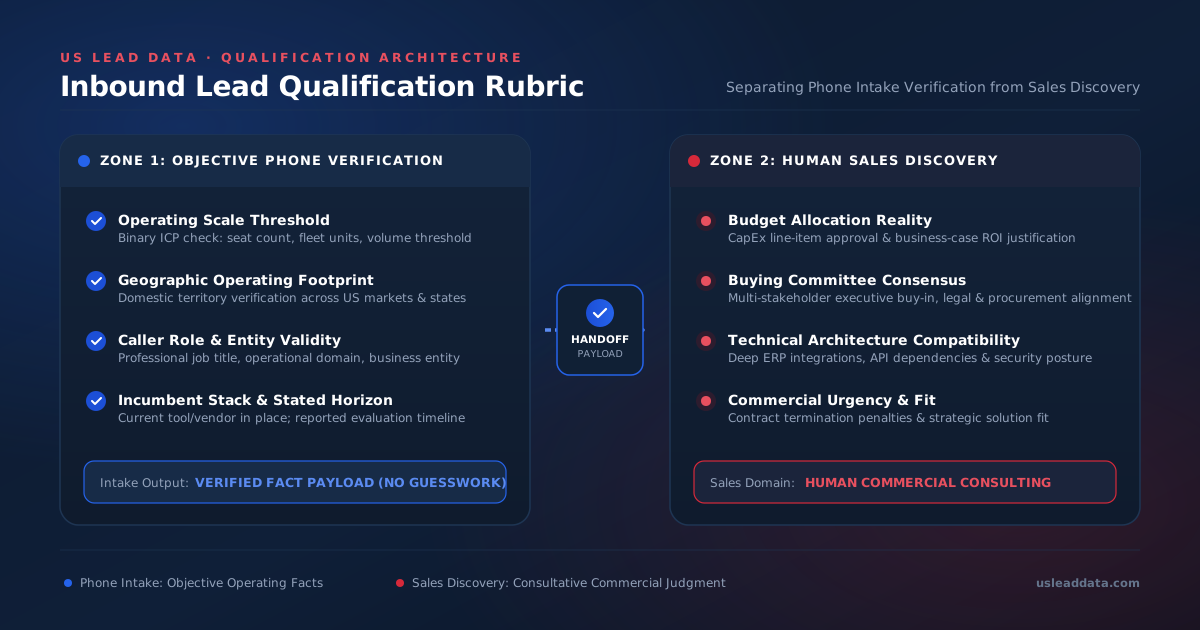
When B2B revenue operations and sales development leaders sit down to build an inbound lead qualification rubric, they frequently encounter two conflicting failure modes:
- The shallow intake trap: The inbound intake collects only superficial contact information—a caller's name, email, and phone number—and immediately dumps the caller onto an Account Executive's calendar. Frontline sales reps find their schedules clogged with consumer inquiries, student researchers, out-of-territory vendors, and small operators far below the company's minimum operating scale. Reps quickly lose trust in inbound pipeline.
- The automated interrogation trap: In reaction to rep complaints, operations leaders attempt to turn a 3-minute intake phone call into an exhaustive commercial discovery session. They script twelve invasive questions about capital expenditure authority, board approval timelines, and multi-department consensus. Callers feel interrogated, refuse to disclose sensitive commercial details to an intake agent, and abandon the call before a sales conversation can ever take place.
Both traps stem from a fundamental misunderstanding of what inbound phone qualification is designed to accomplish.
The direct answer is that a revenue operations or sales development lead establishes an objective qualification rubric by drawing a strict operational boundary: using phone intake to objectively verify concrete operating facts and stated intent, while explicitly reserving commercial judgment, budget consensus, and solution alignment for human sales discovery.
An objective qualification rubric does not rely on opaque "algorithmic lead scoring" or promise guaranteed conversion rates. Instead, it creates a transparent, shared contract between marketing and sales: defining binary qualification criteria, establishing pass/fail intake thresholds, and routing callers based on verifiable facts rather than guesswork.
1. The verification boundary: Objective phone criteria vs. human sales discovery
The most critical architectural decision in building a qualification rubric is distinguishing what can be objectively confirmed during a brief phone conversation from what strictly requires professional sales discovery.
Attempting to verify complex commercial dynamics over an initial phone intake invariably produces distorted data. A prospect calling your inbound line often dials between meetings, from a mobile phone, or during a preliminary evaluation phase. They are willing to confirm factual details about their company; they are rarely willing or able to debate corporate governance or sign-off authority with an intake system.
+-----------------------------------------------------------------------------------+
|               THE INBOUND QUALIFICATION BOUNDARY: PHONE VS. DISCOVERY             |
+-----------------------------------------------------------------------------------+
|  ZONE 1: OBJECTIVE PHONE INTAKE VERIFICATION      ZONE 2: HUMAN SALES DISCOVERY   |
|  (Facts verifiable during initial intake)         (Judgment explored by AE)       |
|                                                                                   |
|  - Operating scale / fleet / seat count           - Buying committee consensus    |
|  - Geographic service territory / states          - Budget allocation reality     |
|  - Caller title / operational role                - Business case & ROI urgency   |
|  - Incumbent software provider / vendor           - Technical architecture fit    |
|  - Stated evaluation timeframe horizon            - Commercial viability & risk   |
|                                                                                   |
|  [Intake Gate: Binary Verification Check]        [Sales Meeting: Opportunity Fit] |
+-----------------------------------------------------------------------------------+
What phone intake CAN objectively verify
Objective phone intake focuses strictly on verifiable operating facts and stated caller parameters:
- Operational scale: Concrete operational metrics that determine your Ideal Customer Profile (ICP). Depending on your business model, this might be number of licensed seats, active fleet vehicles, physical operating facilities, or monthly transaction volume. The caller either meets your minimum operational threshold or does not.
- Geographic operating footprint: Whether the caller's organization operates within the geographic markets, states, or regions your solution supports.
- Caller role and functional domain: The caller's professional title and area of operational responsibility (e.g., Fleet Safety Director, IT Systems Administrator, Operations Manager).
- Incumbent software or provider: The system or vendor the prospect currently utilizes (e.g., legacy on-premise software, an existing competitive vendor, or manual spreadsheets).
- Stated evaluation horizon: The caller's self-reported timeline for implementing a solution (e.g., active project this quarter, upcoming contract expiration in six months, or preliminary exploration for next fiscal year).
- Primary business challenge: The specific operational pain point or use case that triggered the inbound phone inquiry.
What phone intake CANNOT objectively verify (and why discovery owns it)
Attempting to force the following dimensions into an initial phone intake creates friction and inaccurate lead data:
- Budget allocation and funding reality: Asking "Do you have a dedicated budget allocated for this initiative?" on a first call almost always triggers defensive or misleading responses. An operational manager may not know the exact line-item budget status, while an executive may strategically claim "no budget" to preserve negotiating leverage. True budget viability is discovered by an Account Executive through business-case justification.
- Buying committee consensus: Whether the Chief Technology Officer, Head of Procurement, and Chief Financial Officer will agree on a purchase cannot be confirmed in an intake call. Assessing multi-stakeholder political alignment is the explicit core of human consultative selling.
- Technical architecture compatibility: Detailed API dependencies, custom ERP integrations, and enterprise security controls require deep technical discovery and solution engineering, not a surface-level intake checklist.
- Commercial urgency: A caller may state a timeline of "within 30 days," but only a skilled sales rep can uncover whether that date is tied to a hard contractual penalty, a regulatory deadline, or merely an arbitrary personal preference.
When revenue leaders respect this boundary, the phone intake does its job—filtering out unqualified inquiries and capturing structured operating context—without overstepping into discovery.
2. The four structural pillars of an objective qualification rubric
To operationalize this boundary, an objective qualification rubric organizes caller information into four structured pillars:
+-----------------------------------------------------------------------------------+
|                  THE FOUR STRUCTURAL PILLARS OF A LEAD RUBRIC                     |
+-----------------------------------------------------------------------------------+
|  1. IDENTITY & ENTITY      2. BASELINE ICP          3. STATED INTENT    4. ROUTING|
|     VERIFICATION              THRESHOLDS               & CONTEXT           ACTION |
|  - Caller Name             - Operating Scale        - Primary Need      - Live AE |
|  - Company Entity          - Geographic Scope       - Incumbent Stack     Transfer|
|  - Role / Department       - Business Model         - Timeline Window   - AE Queue|
|  - Phone & Email           - ICP Tier Fit           - Pain Trigger      - Nurture |
+-----------------------------------------------------------------------------------+
Pillar 1: Identity and entity verification
Before any qualification logic evaluates a lead, the intake must establish basic entity validity:
- Who is calling? (Caller full name, verified direct callback number, corporate email).
- What company do they represent? (Legal business entity, verified website domain).
- What is their role? (Job title and functional level within the organization).
Verification rule: If the caller cannot provide an identifiable corporate entity or operational role, the record is flagged as unverified and does not trigger an immediate sales rep interruption.
Pillar 2: Baseline ICP thresholds (Hard pass/fail criteria)
These are non-negotiable operational boundaries that determine whether an organization can physically or commercially use your product:
- Scale threshold (e.g., minimum 25 employees, 15 vehicles, or $2M in annual logistics spend).
- Geographic boundary (e.g., operations located within the continental United States).
- Business model (e.g., B2B commercial entities, excluding consumer or retail inquiries).
Verification rule: These criteria must be binary. If a caller operates 3 vehicles and your minimum ICP is 15, the rubric does not route them to an AE; it directs them to self-serve documentation or a lower-tier informational path.
Pillar 3: Stated intent and operational context
Once baseline ICP fit is confirmed, the rubric captures the caller's stated context so the receiving rep never starts from zero:
- What operational challenge triggered the call today?
- What software, hardware, or manual process are they currently using?
- What is their stated implementation horizon (e.g., Immediate/30 days, 60–90 days, 6+ months)?
Verification rule: Context must be recorded as explicit caller quotes or structured dropdown values, never as inferred assumptions.
Pillar 4: Handoff decision and payload delivery
The rubric defines explicit routing outcomes based on the intersection of ICP thresholds and stated intent:
- Outcome A: Live sales transfer: Caller meets all ICP thresholds AND states an active project timeline (e.g., next 30–60 days) AND requests immediate discussion.
- Outcome B: Structured AE queue record: Caller meets ICP thresholds, but requests asynchronous callback or calls outside standard sales coverage hours. Complete context payload delivers directly to the CRM/AE queue.
- Outcome C: Alternate routing / self-serve nurture: Caller falls below ICP thresholds or seeks non-sales services (e.g., customer support, billing, employment). The intake routes them to the appropriate department without consuming sales rep bandwidth.
3. The danger of "algorithmic lead scoring" on inbound phone calls
Many sales technology vendors promote automated lead scoring algorithms that promise to assign an arbitrary numeric score (e.g., "Lead Score: 84/100") to an inbound caller based on machine learning models or black-box formulas.
Revenue operations leaders should approach phone-based numeric scoring with extreme caution for three operational reasons:
- False precision masks missing data: A lead score of "78" tells an Account Executive nothing about why the lead is valuable. Does a 78 mean the company is huge but lacks intent? Or does it mean the caller is desperate to buy but represents a tiny 2-person shop? Reps cannot prepare a discovery call based on a synthetic number.
- Brittle point weighting: Arbitrary point formulas (e.g., +10 points for Director title, +15 points for timeline under 30 days) incentivize intake agents to fish for specific high-scoring buzzwords rather than having a natural, professional business conversation.
- Erosion of sales-marketing trust: When an AE takes a meeting with an "88-point" lead who turns out to be an intern doing academic research, the rep loses faith in the entire scoring system.
The better alternative is transparent, binary criteria and structured context payloads. Instead of giving reps a black-box score, give them the exact verified facts:
- Entity: Acme Logistics (55 fleet vehicles across TX and OK).
- Contact: Marcus Vance, Director of Safety.
- Incumbent: Legacy telematics system expiring in November.
- Stated Need: Automated driver coaching to lower insurance premiums.
- Timeline: RFP planned for Q4.
With structured context, the Account Executive knows exactly how to open the sales discovery conversation.
4. Blank illustrative qualification rubric planning worksheet
Before programming an inbound call flow, revenue operations and sales development leaders should complete this planning worksheet to align on criteria, thresholds, and discovery boundaries:
| Qualification Dimension | Objective Phone Intake Question Wording | Verification Rule / Pass Threshold | Routing Action / Destination Payload | Deferred to Human Sales Discovery (AE Domain) |
|---|---|---|---|---|
| 1. Entity & Identity Verification | "May I confirm your company name and your current role?" | Identifiable commercial entity; corporate email/phone verified. | Pass → Proceed to ICP scale. Fail → Flag unverified inquiry; route to generic intake inbox. |
Org chart hierarchy, executive sponsor access, internal politics. |
| 2. Operating Scale Threshold (ICP) | Primary scale question (e.g., seat count, fleet size, facility count). | Minimum threshold: [e.g., ≥ 25 seats, ≥ 15 vehicles]. | Pass → Meets ICP tier. Fail → Divert to SMB or self-serve educational resource. |
Long-term expansion potential, total addressable department budget across divisions. |
| 3. Geographic Scope & Territory | "In which states or regions does your company operate?" | Operates within defined domestic service markets. | Pass → Proceed to intent. Fail → Out-of-territory notice and referral path. |
Regional rollout sequencing, cross-border compliance, tax jurisdiction specifics. |
| 4. Incumbent Stack & Workaround | "What software or system are you currently using for this?" | Captures existing tool, legacy provider, or manual process. | Log current vendor in lead payload for rep preparation. | Contractual end-date penalty, integration friction points, user dissatisfaction depth. |
| 5. Stated Timeline Horizon | "What timeframe are you working toward for a rollout?" | Stated active evaluation: Active (≤ 90 days) vs. Exploratory (> 90 days). | Active (≤ 90d) → AE Transfer / Priority queue. Exploratory → Nurture digest. |
Capital expenditure approval, procurement review cycle, formal RFP milestone dates. |
| 6. Primary Business Driver | "What specific operational challenge prompted your call?" | Clear stated problem captured verbatim. | Structure pain point in AE lead briefing dossier. | Financial impact & ROI case, quantified loss of current operating bottlenecks. |
5. Illustrative scenario: Applying the rubric in a B2B fleet operations platform
To see how an objective qualification rubric functions in practice, consider the following Illustrative Example:
Illustrative Example: FieldPro Telematics
FieldPro Telematics is a US-based B2B software provider selling GPS fleet tracking, driver compliance, and route optimization software to commercial transportation and service fleets.
The Problem: FieldPro's four Account Executives were spending over 35% of their working hours fielding inbound phone inquiries from single-truck owner-operators who could not afford their enterprise platform, or from existing drivers calling for technical device support. Meanwhile, high-value commercial fleet directors calling during peak hours were frequently sent to voicemail.
The Rubric Implementation: FieldPro's Head of Revenue Operations and Sales Development Manager collaborated to establish an objective qualification rubric:
- ICP Scale Threshold: Minimum 15 commercial power units (vehicles).
- Geographic Scope: Operations in the United States.
- Verification Boundary:
- Verified by phone intake: Fleet size, operating state, caller role, current telematics vendor, and stated project timeframe.
- Deferred to AE discovery: Total fleet replacement budget, driver committee buy-in, cellular carrier contract termination fees, and custom ERP integration requirements.
Three Inbound Calls Evaluated Under the Rubric:
- Call A (Qualified Active Evaluation): A safety manager from a regional construction firm with 48 service trucks in Ohio calls. The phone intake confirms 48 vehicles (exceeds the 15-vehicle threshold), US domestic operations, an incumbent vendor contract expiring in 60 days, and an active search for automated dashcams.
Rubric Outcome: The call meets all Tier-1 ICP criteria. The intake agent offers an immediate warm transfer to an available mid-market AE, passing a complete structured record into the CRM.- Call B (Sub-ICP Inquirer): An owner-operator with 2 landscaping trucks calls seeking vehicle tracking. The intake asks for fleet size; the caller states 2 trucks.
Rubric Outcome: The intake politely recognizes that FieldPro's enterprise telematics platform is designed for fleets of 15 vehicles or more. The intake agent offers to send an automated SMS link to FieldPro's partner directory for small-fleet operators, politely ending the call without interrupting an AE.- Call C (Non-Sales Support Intent): An existing customer's field driver calls asking how to reset an electronic logging device (ELD) in their truck.
Rubric Outcome: The intake recognizes non-sales support intent, collects driver ID and vehicle number, and routes the caller directly to the technical support queue.(This scenario is a labelled illustrative example for rubric design and workflow planning; it does not represent an actual customer endorsement, proprietary integration, or guaranteed sales conversion outcome.)
6. How US Lead Data supports qualification rubrics and disciplined handoffs
At US Lead Data, our service is purpose-built for US B2B sales and demand-generation teams that value lead quality over raw call volume. We provide an inbound AI phone agent engineered for deep lead intake, structured qualification, and disciplined sales handoffs.
Sales-assisted initial setup and customer platform control
Designing and refining your qualification rubric does not require software engineering:
- Sales-assisted initial setup: When you launch phone service, a dedicated sales agent works directly with your revenue leadership to map your qualification criteria, define pass/fail thresholds, and configure your intake questions.
- Customer platform control: As your Ideal Customer Profile evolves, new products launch, or rep availability shifts, later changes can be made in the platform, and support is available for additional assistance. Your team maintains full authority over your qualifying questions and handoff rules.
Transparent, predictable subscription terms
US Lead Data operates under uniform, transparent commercial terms:
- Standard subscription: The standard AI Phone Agent subscription is $199 per month, billed month to month.
- Zero upfront fees: There is no setup fee or onboarding fee ($0 setup fee).
- Included monthly allowances: Each monthly billing period includes 500 inbound voice minutes and 500 SMS text messages.
- Predictable metered overages: Usage beyond monthly allowances is billed at $0.12 per additional minute and $0.02 per additional SMS.
- Month-to-month flexibility: Cancel before the end of the current billing period to prevent renewal for the next period. Phone service remains available through the paid period; overage charges already incurred remain due. Refunds for prepaid monthly phone service are considered case by case. Full terms are published in our Terms of Service.
Category boundary and portfolio differentiation
To ensure clarity across our portfolio of specialized brands:
- US Lead Data (
usleaddata.com): Built for US B2B sales and demand-generation teams requiring deep qualification criteria, verification of caller context, and structured sales-ready handoffs. - Get Your Lead Data (
getyourleaddata.com): Built for rapid SMB lead capture and immediate lead routing, prioritizing speed-to-lead over complex qualification depth. - Lead Data Warehouse (
leaddatawarehouse.com): Built for enterprise data pipeline normalization and multi-department CRM data warehouse schemas. - Enterprise HD (
enterprisehd.com): Built for corporate-wide governance, division-level access control, and enterprise procurement requirements. - Standard Lead Data (
standardleaddata.com): Built for sales operations teams evaluating immediate calendar booking requests versus structured intake records.
US Lead Data provides the conversational infrastructure to execute your qualification rubric across US markets and time zones, while your team maintains complete ownership of your qualification criteria, handoff rules, and sales discovery judgment.
Summary and next steps for revenue leaders
An effective lead qualification rubric transforms inbound phone calls from an unpredictable distraction into a structured source of qualified pipeline. By defining what your phone intake can objectively verify, reserving commercial judgment for human discovery, and structuring the handoff payload, you protect sales rep selling time and deliver a seamless experience to high-intent buyers.
- Map your qualification rubric: Talk through your inbound sales path with our team or start phone service directly.
- Explore our workflow: Read How US Lead Data Works and consult our FAQ.
- Understand context delivery: Read What qualification context should reach sales.
- Set your handoff rules: Read How to set a sales handoff rule for inbound calls.
- Audit sales pushback: Read What to review when sales says an inbound lead was not ready.
- Operational checklist: Read A sales-handoff checklist for inbound lead calls.
- Review our service terms: Read the complete Terms of Service.